Converting a Tennis Court into Padel Courts
Plenty of tennis clubs, hotels and council sports grounds have courts that stand empty for much of the week, while their padel courts, if they have any, run waiting lists. That is why so many operators look at how to convert a tennis court to padel. Because part of the site, the perimeter fence, the lighting and the services may be reusable, a conversion can be quicker than building a new venue from scratch. Not every tennis court converts equally easily, though. This guide covers how many padel courts fit on a tennis court, how the existing base is assessed, how anchoring and drainage are handled, and what the timeline looks like.
To apply this guidance to your own project, see our padel court cost page.
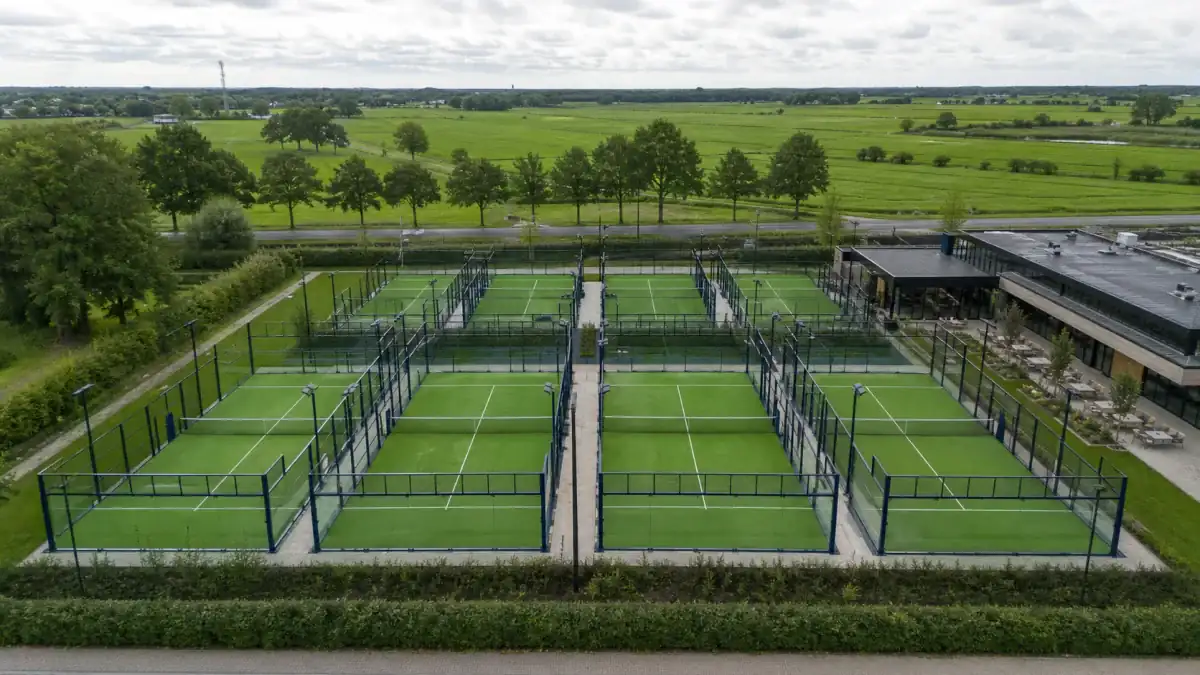
Short answer: On the footprint of one tennis court, two or three padel courts can usually be planned when they are set across the tennis court. A padel court is 20 metres long, which is more than the width of most tennis enclosures, so the base often needs extending at the sides. Whether the existing base can be reused is decided by an on-site assessment.
Why tennis clubs are adding padel
As padel has grown, many tennis clubs have added courts to broaden their membership and increase revenue per square metre. Padel is played in doubles, so each court has four players at a time. It is quicker to pick up than tennis, and players of different levels can enjoy a game together. That strengthens the social side of a club and supports secondary income from coaching, the café and tournaments.
When deciding, weigh the needs of existing tennis members too. Starting with the least-used tennis courts, rather than converting them all, is a common way to keep the balance within the club. Your booking data will show which courts sit empty and when, which gives the decision a factual basis.
How many padel courts fit on a tennis court
The answer depends on the total area inside the fence, not on the tennis playing area. A tennis doubles court measures about 23.77 × 10.97 metres; with run-off, the fenced area of a single court is commonly around 34–37 metres long and 17–18 metres wide. A padel court is 20 × 10 metres internally, and its steel frame adds a little to the external size.
Layout options
- Padel courts across the tennis court: courts sit side by side along the length of the tennis court. The length is often enough for three courts, but the 20-metre court length exceeds a typical tennis court’s width, so the base may need extending on one or both sides.
- Two courts with wider walkways: if extending the base is impossible or costly, two courts with comfortable circulation can be more practical. The 20-metre court length still has to fit, so measure first.
- Two adjacent tennis courts: converting a pair of neighbouring tennis courts together uses the space more efficiently and can increase the court count.
The exact number comes from a site measurement and a layout drawing that includes door positions, walkways and lighting columns. Our guide to padel court dimensions covers the basic measurements.
Assessing the existing base
Tennis courts may be built on concrete, asphalt, acrylic-coated hard courts, clay or artificial grass. A padel court is a heavy steel and glass structure fixed with anchors, and it needs a flat artificial turf surface. The existing base has to be checked on three points.
Flatness and falls
Tennis courts are built with a slight fall for drainage. That fall may be within acceptable limits for padel or may need correcting. Local depressions and undulations must be dealt with before turf is laid.
Cracks and surface damage
Asphalt surfaces develop age cracking, and concrete slabs often show opened joints. Surface cracks can be repaired, but deep cracks caused by settlement in the layers below may mean partly or fully renewing the base.
Load capacity and thickness
Padel court anchors transfer significant forces, especially on panoramic models with large glass panels exposed to wind. If the thickness and reinforcement of the existing slab are unknown, take cores to check them. Flexible surfaces such as asphalt are rarely enough to anchor into on their own, so reinforced concrete strips or pad foundations are formed at the anchor points.
Anchoring, drainage and fall correction
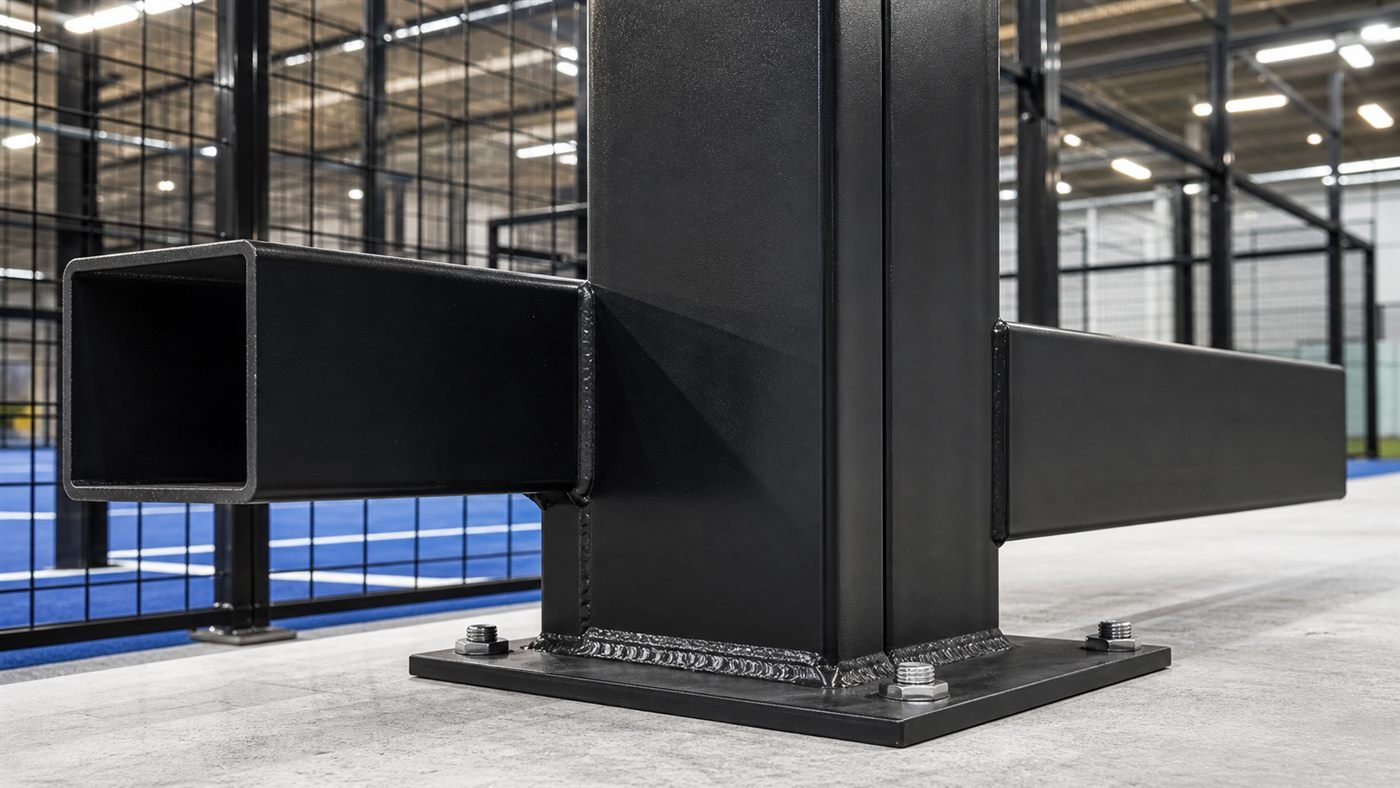
The most critical technical question in a conversion is how the court is fixed safely to the existing base. The anchor plan follows the post positions of the chosen court model, and concrete quality, edge distance and embedment depth are checked for each anchor. Where the existing base is not adequate, a new perimeter beam around the court is the most common solution.
The tennis court’s existing drainage pattern may not suit the padel layout. Because the glass walls of a padel court block surface run-off, you need to replan where water collects and how it leaves the court. Our article on padel court foundations and drainage covers the design in detail.
Conversion checklist
- Net dimensions and levels inside the tennis fence
- Base type, thickness and core results
- Existing drainage channels and outfalls
- Whether existing lighting columns suit the new layout
- Whether the perimeter fence stays
- Crane and delivery access
Converting five-a-side pitches and other areas
Conversions are not limited to tennis. Five-a-side pitches, basketball and volleyball courts, car parks and unused hard areas can also become padel courts. On a five-a-side pitch, the existing artificial grass is usually removed and the layers beneath inspected. Infilled systems rarely sit on concrete suitable for anchoring, so a new base or anchor beam is generally needed.
Car parks and concrete yards can offer good load capacity, but their falls are often steep and surface water is routed differently. For every type of area, the first step is the same: measure the site, assess the base and draw a layout. You can see which stages of our padel court construction service apply to a conversion on that page.
Budget and timeline to convert a tennis court to padel
The conversion budget depends on how much of the base can be reused, whether it needs extending, the anchoring solution, drainage work, the court model and whether the lighting can be adapted. When the base is in good condition and the lighting can be reused, both cost and programme drop noticeably. When the base has to be renewed, the project comes close to a new build.
In the programme, the longest items are usually court production and, where new concrete is poured, the time it needs to gain strength. On-site assembly is relatively short once the base is ready. The club does not have to close: the work area can be fenced off while other courts stay in use.
You can see our ten panoramic court references in the Netherlands on our projects page.
Let us look at your tennis court
Send us the dimensions of your tennis court, the surface type and a few photos. The Padel Court team will give you a first view of how many padel courts could fit and how much of the existing base might be reused. Get in touch through our contact page.
Frequently Asked Questions
Can the tennis court base be reused for padel?
Sometimes. A concrete base that is thick enough, flat and free of structural cracks can take anchors and turf. Asphalt or damaged bases usually need new concrete strips or foundations at the anchor points. The decision is based on site measurements and core samples.
Do two padel courts fit comfortably on one tennis court?
In terms of length, usually yes: two courts with a walkway between them fit along a tennis court. Because a padel court is 20 metres long, you also need to check that the fenced width of the tennis court is enough. Where it is not, the base is extended at the sides.
Does the club have to close during conversion?
No. Once the work area is fenced off and made safe, other courts can stay in use. Plan crane and delivery access separately from member traffic and schedule noisy work at suitable times.