How Should Padel Court Lighting Be Planned?
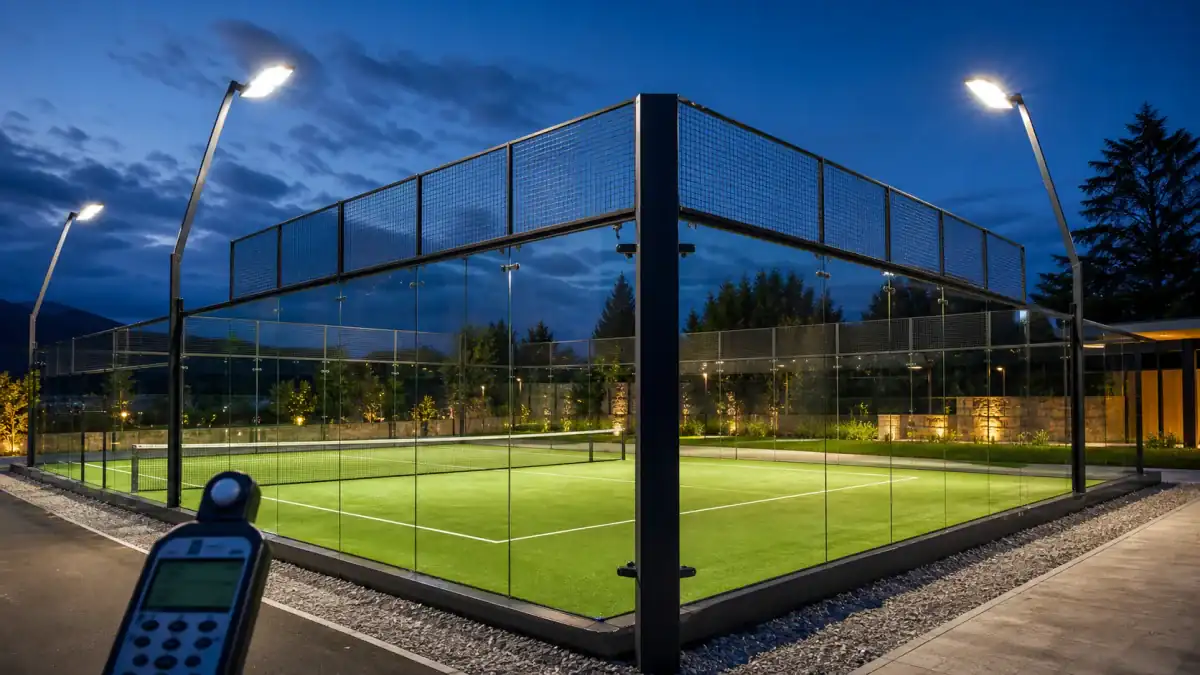
Padel court lighting is designed not simply to make a court look bright, but to keep a fast-moving ball visible, protect player comfort and provide balanced camera images. Average illuminance matters, but so do uniformity and glare control.
Short answer: What makes good padel lighting?
Good padel lighting distributes light evenly across the playing surface, avoids direct glare in player sightlines and can be controlled for the intended use. Performance targets should reflect social play, club training, competition or broadcast needs.
1. Define the operating scenario
A booking-led club and a venue intended for filmed events do not have identical objectives. Playing level, operating hours, nearby homes and possible future broadcasting should be stated at the start.
2. Why uniformity matters
Hard transitions between bright and dark zones make ball tracking difficult. The design should assess distribution across the whole court, not only a few points. Reflections from glass surfaces also need consideration.
3. Mast and luminaire positions
Masts must avoid conflict with the playing area, doors and glass joints. Asymmetric optics direct light where it is needed and help limit glare when a player looks upward.
4. Energy and control
- Individual court switching or automation
- Different scenes for quiet periods
- Outdoor equipment with suitable protection
- Safe maintenance access and replaceable drivers
5. Commissioning
After installation, field measurements should be compared with the design. Luminaire aiming can then be fine-tuned and final results handed to the maintenance team.
Conclusion
Padel Court treats lighting as a technical system working with glass, steel, the playing surface and the operating model—not as an isolated accessory.